SEO for Wholesalers: How to Secure Supplier, Wholesale, and Partner Backlink
SEO for wholesalers comes down to one question: when a retailer searches for a supplier, does your site show up and look trustworthy?
Product pages and keywords get you indexed, but Google and B2B buyers both trust by who links to you. For a wholesaler, the strongest proof comes from suppliers, directories, and partners you already work with.
How to Secure Supplier, Wholesale & Partner backlinks at a glance
| Backlink Type | Where to Find | How to Secure |
|---|---|---|
| Supplier backlinks | “Where to Buy” and dealer locator pages | Ask your account manager for a listing |
| Wholesale directory backlinks | Niche B2B directories, trade association member lists | Build a complete profile with consistent details |
| Partner & distributor backlinks | Retailer “Brands We Carry” and partner pages | Offer a testimonial, case study, or logo kit |
I tested the steps about how to secure supplier backlinks for wholesalers in this guide on a 108-contact campaign using Uprankly’s Link Planner and Link Builder. You will see the exact filters, settings, and reply numbers, plus an email template you can copy.
What Makes SEO for Wholesalers Different from Regular SEO?
Wholesale SEO targets business buyers, not end consumers, while regular SEO chases individual shoppers who want one product fast.
Wholesale buyers search for suppliers, bulk pricing, and long-term partners, so your pages and links must prove you are reliable. On the other hand, a retail buyer might compare 3 stores and check out in 10 minutes.
The table below shares side-by-side differences between wholesale SEO and regular SEO.
| Factor | Wholesale SEO | Regular SEO |
|---|---|---|
| Target audience | Retailers, resellers, procurement teams | Individual consumers |
| Search intent | Find a reliable supplier | Buy a product now |
| Keywords | “bulk,” “wholesale,” “supplier,” “MOQ” | Product names, “best,” “cheap,” “near me” |
| Sales cycle | Weeks to months | Minutes to days |
| Content focus | Catalogs, pricing tiers, shipping terms | Product pages, reviews, deals |
| Trust signals | Certifications, partner logos, trade memberships | Ratings, reviews, return policy |
| Backlink sources | Suppliers, distributors, trade directories, associations | Bloggers, influencers, review and coupon sites |
What Is in a Wholesale SEO Checklist?
A wholesale SEO checklist covers 6 areas: keyword research, technical SEO, content, on-page SEO, link building, and measurement. Work through the list in order, since strong links help most when the target pages already answer buyer questions. Review the full list once a quarter.
Keyword Research
- Target “wholesale,” “bulk,” “supplier,” and “distributor” keyword variations
- Find buyer questions about MOQ, lead times, and private label options
- Map one main keyword to each catalog or category page
- Check which wholesale keywords competitors rank for and you do not
Technical SEO
- Keep catalog and category pages indexable, even if prices sit behind a login
- Fix duplicate product pages created by filters, sizes, and colors
- Test page speed on large catalog and product listing pages
- Submit an updated XML sitemap after adding new product lines
Content
- Publish guides buyers need, like an MOQ explainer or bulk pricing guide
- Add shipping terms, return rules, and payment terms to a clear FAQ page
- Create case studies with real retail partners
- Build one linkable resource page per main product category
On-page SEO
- Use the main keyword in the title tag, H1, and URL
- Show MOQ, pricing tiers, and lead times near the top of each page
- Display certifications, trade memberships, and partner logos
- Link category pages to the “Apply for a wholesale account” page
Link Building / Backlinks
- Check every supplier’s “Where to Buy” page for your listing
- Join 3 to 5 niche wholesale directories and trade association lists
- Pull competitor backlinks and filter by traffic, DA, and relevance
- Verify emails, send one follow-up after 3 days, and decline paid link offers
Measurement
- Track wholesale pages separately in GA4
- Add a “How did you find us?” field to the account application form
- Log reply types for every outreach campaign, not just links won
- Check won links monthly and compare rankings 4 to 8 weeks after each new link
What are the Backlink Types for Wholesalers & How to Secure?
Wholesalers can earn three main backlink types: supplier backlinks, wholesale directory backlinks, and partner or distributor backlinks.
Each link type comes from a business you already deal with or a platform buyers already use. So you can secure most wholesale links through existing relationships, not cold outreach.
Supplier Backlinks
Supplier backlinks are links from the manufacturers and brands whose products you sell. Supplier links usually sit on “Where to Buy,” “Authorized Dealers,” or dealer locator pages. Most suppliers already keep dealer pages, so getting listed is often a simple request.
How to secure supplier backlinks:
- List every supplier you buy from: Start with the brands that bring the most revenue.
- Check each supplier site for a dealer page: Search Google with site:supplier.com “where to buy” or site:supplier.com “dealers”.
- Mark the gaps: Supplier pages that list competitors but skip you are your quickest wins.
- Email your account manager, not the general inbox: Account managers already know your business and can pass the request to the web team.
- Send every detail in one email: Include business name, address, phone, website URL, logo, and the product lines you carry.
- Follow up after one week: Then check the listing every month, since supplier sites often drop dealer listings during redesigns.
Outreach Sample
“Hi [Name],
We have stocked [Brand] products for [X] years.
Could you add [Company] to your Where to Buy page?
Our listing details are below…..”
If you run supplier outreach across dozens of brands, Uprankly’s Link Builder can find and verify contacts, send the emails, and track every follow-up in one place.
Wholesale Directory Backlinks
Wholesale directory backlinks are links from B2B platforms where buyers search for suppliers. Examples include industry directories like Thomasnet or Wholesale Central, trade association member lists, and local chamber of commerce pages. Most directories offer a free or paid company profile with a link to your site.
A good directory link puts your business in front of buyers who are already comparing suppliers. Niche directories also tell Google which industry your site belongs to.
How to secure wholesale directory backlinks:
- Find directories in your niche: Search Google for [your product] wholesale directory or [your industry] supplier directory.
- Check trade associations you already belong to: Many associations list members with a link, but you often have to request the link.
- Vet each directory before you sign up: Search site:directory.com in Google to confirm the pages are indexed. Skip directories that list any business in any niche.
- Pick paid listings with care: Pay only when the directory sends real buyer traffic in your category, not just a link.
- Fill out the full profile: Add product categories, MOQ, certifications, shipping regions, and photos. Complete profiles rank higher inside the directory search.
- Keep your NAP details the same everywhere: Use one business name, address, and phone format across every listing.
Partner & Distributor Backlinks
Partner and distributor backlinks are links from the businesses that buy from you, sell for you, or ship for you. Common sources include retailers you supply, regional distributors, resellers, and logistics or packaging partners. Partners often link to wholesalers on “Our Suppliers,” “Brands We Carry,” or partner pages.
A partner link proves that real businesses trade with you. Buyers who check a retailer’s supplier list may click straight through to your site.
How to secure partner and distributor backlinks
- Rank your partners by relationship strength: Start with high-volume, long-term accounts that already value your service.
- Check partner sites for supplier or brand pages: Note which partners list other suppliers but not your business.
- Offer a testimonial: Write a short review of a logistics or software partner. Many partners publish testimonials with a link back to the reviewer.
- Pitch a joint case study: Share real results, like faster restocks or lower shipping costs. Both sides get content, and your partner links to your site.
- Make linking easy for retailers: Send a ready kit with your logo, a short brand description, product images, and your URL.
- Ask during natural touchpoints. Bring up the link at contract renewals, quarterly reviews, or after a big order.
How to Find Wholesale Backlink Opportunities
You can find wholesale backlink opportunities in five places: competitor backlink profiles, supplier websites, unlinked brand mentions, industry resource pages, and broken links on niche sites.
Once you have a list, you qualify each site, find the right contact, and run outreach with a planned follow-up.
I ran the full process on a campaign before writing the guide. I used 2 Uprankly tools: Link Planner to pull prospects from a competitor’s backlink profile, and Link Builder to enrich contacts and run the outreach. I emailed 108 contacts in total.
The campaign promoted a Shopify site. My numbers appear inside each step below.
Where to Find Wholesale Backlink Prospects
You can check competitor backlinks, supplier sites, brand mentions, resource pages, and broken links to find wholesale backlink prospects.
Analyze Competitor Backlinks
Competitor backlinks show you which sites already link to businesses like yours. A site that links to a competing wholesaler will often accept a link to your store, too. Start with competitor research because the method gives you the largest prospect list in the shortest time.
How I ran the step: I created a project in Uprankly’s Link Planner and added one competitor domain. Link Planner pulled 1,000 referring domains from the competitor’s backlink profile in one run.
For wholesalers: Pick 3 to 5 competitors who rank for your main “wholesale [product]” keywords. Look for distributor lists, trade blogs, and directories that link to the competitors but not to you.
Check Supplier Websites
Supplier websites are the easiest link source a wholesaler has. Check each supplier site for “Where to Buy,” dealer locator, or case study pages. Any supplier page that lists a competitor but skips your business goes straight onto your prospect list.
The Supplier Backlinks section above covers the full outreach steps for supplier links.
Find Unlinked Brand Mentions
An unlinked brand mention is a page that names your business but does not link to your site. The writer already knows your brand, so a link request is a small ask. Unlinked mentions are often the fastest links to win.
- Set up Google Alerts: Add your business name in quotes, plus your top product lines and common misspellings.
- Search for older mentions: Use intext:”Your Brand” -site:yourbrand.com in Google.
- Sort linked and unlinked mentions:. Open each page and check whether your brand name is clickable.
- Prioritize the strong pages: Keep pages with real traffic, niche relevance, and a positive tone. Skip thin or spammy pages.
- Email the author or editor: Thank the writer, share the exact URL, and keep the ask simple enough to act on in 30 seconds.
While you review each page, also look for wrong details like an old address, outdated pricing, or the wrong MOQ. Ask for the correction in the same email as the link request.
For a deeper walkthrough, see how online stores turn unlinked brand mentions into backlinks, and our guide on how to audit brand mentions.
Search Industry Resource Pages
Resource pages are curated lists of useful links in a niche. Trade blogs, associations, and buying guides often keep “supplier resources” or “where to source” pages. A wholesaler with a useful page, like a bulk pricing guide, a sizing chart, or an MOQ explainer, fits resource lists well.
Try these Google searches:
- “[your product]” suppliers inurl:resources
- “wholesale [product]” intitle:resources
- “[your industry]” “useful links”
Pitch a specific helpful page, not your homepage. Resource page editors link to answers, not storefronts. For more pitch angles, see our guide to winning resource page backlinks.
Identify Broken Link Opportunities
Broken link building means finding dead links on niche sites and offering your page as a replacement. Wholesale niches usually have many dead links because suppliers close, rebrand, or change URLs often.
- Take the resource pages and directories from the earlier steps.
- Run each page through a free broken link checker, like the Check My Links Chrome extension.
- Note dead links that point to closed suppliers or removed product pages.
- Email the site owner with the dead URL and your working replacement page.
Run each page through a free broken link checker, like the Check My Links Chrome extension.
Wholesale Backlink Outreach Process
The wholesale backlink outreach process has five steps: build a prospect list, qualify each site, find the right contact, send a personalized email, and follow up once or twice. Each step below shows the exact settings and numbers from my test campaign.
Build a Prospect List
Combine prospects from all five sources into one list, in a spreadsheet or one of the link prospecting tools built for the task. My competitor analysis in Link Planner alone produced 1,000 domains. A raw list always includes dead sites, zero-traffic sites, and off-topic sites, so never email a raw list.
For each prospect, record the domain, the source (competitor, supplier, mention, resource page, or broken link), the target page URL, and a short note on why the site fits.
Qualify Potential Websites
Qualifying removes the sites that waste your outreach time or weaken your link profile. I enriched all 1,000 domains with Domain Authority (DA), total backlinks, referring domains, and organic traffic. Then I exported the enriched data to Google Sheets and applied three filters:
| Filter | Range I used |
|---|---|
| Organic monthly traffic | 1,000 to 100,000 |
| Domain Authority | 20 to 60 |
| Domain extensions | .com, .org, .co.uk, .com.au, .io, .ai |
The filters cut 1,000 raw domains down to 119 qualified targets. Close to 9 out of 10 prospects did not make the cut.
For wholesalers: Add a relevance check. A site should cover your product category, your buyer type, or your region. Small trade sites often have a low DA but real buyer traffic, so loosen the DA floor for strong niche matches.
Find the Right Contact
A generic info@ inbox rarely reaches the person who edits pages. Target the editor or content manager on publisher sites. On supplier and partner sites, target your account manager.
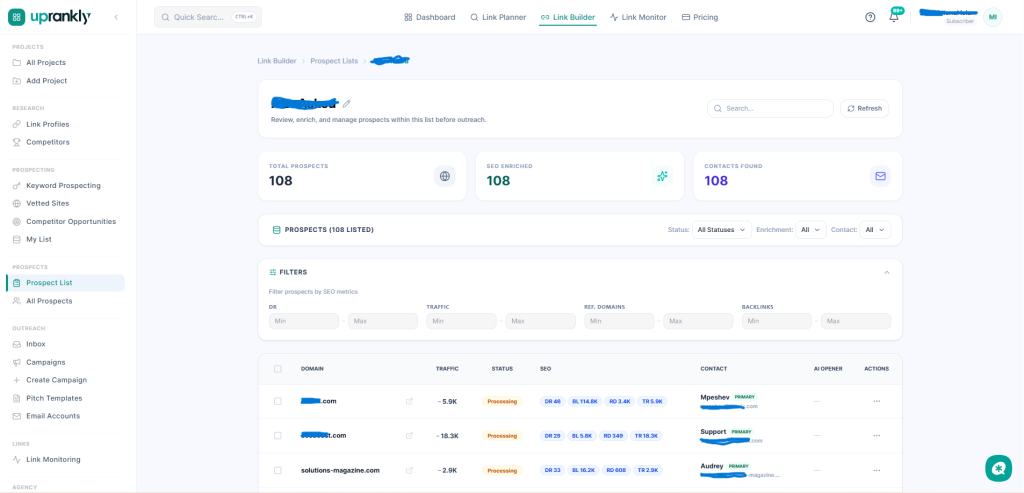
I mapped the 119 domains into a CSV and imported the file into My List in Uprankly’s Link Builder. Link Builder ran contact enrichment and returned valid contacts for 108 domains. I removed the 9 domains without contact data.
The clean list paid off. 105 of my 108 emails landed (97.2% delivery), and only 3 bounced (2.8%).
Write a Personalized Outreach Email
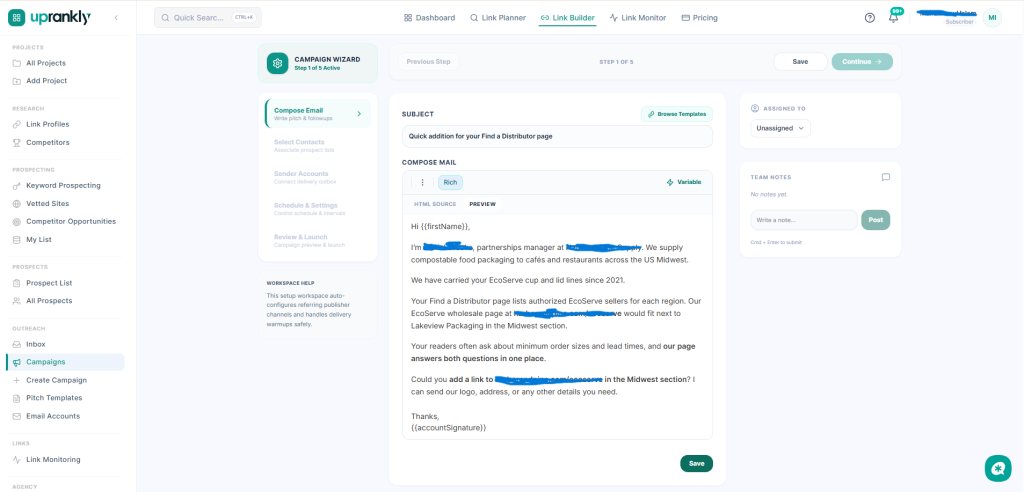
A personalized email names the recipient’s page, explains your connection, and suggests one specific link. Generic pitches get ignored because the recipient sees no reason to act.
My campaign settings in Link Builder:
- Format: HTML pitch email
- Sender: One pre-configured sender account
- Daily limit: 30 emails per day
- Open tracking: On
A cap of 30 emails per day protects your sender reputation, which matters most when you send from a new domain. My pitch reached a 35.2% open rate. Use the template at the end of this guide as your starting point.
Follow Up Without Spamming
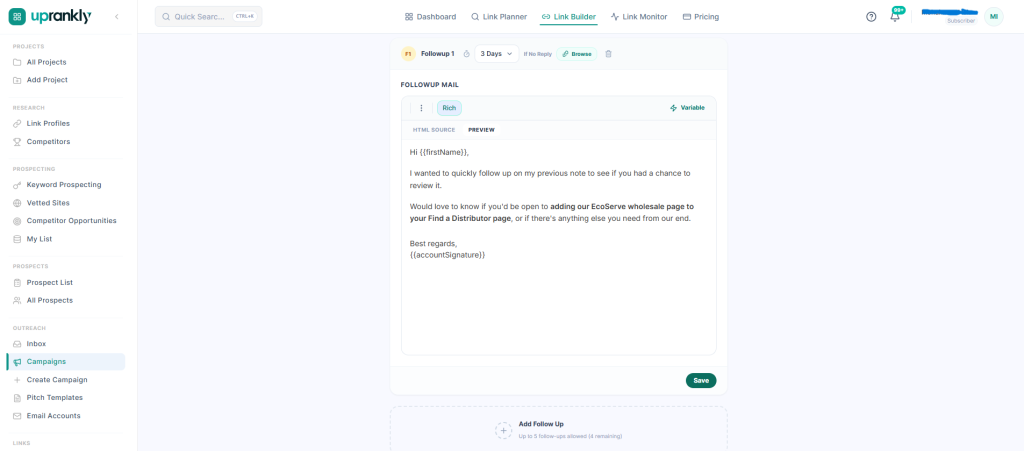
Send one follow-up 3 days after the first email. I set the follow-up as an automated step inside the Link Builder campaign, so I never had to track dates by hand.
For more on safe automated sequences, see our link building automation workflow breakdown.
Only 8 of my 108 contacts replied (7.4%). Without a follow-up, the other 100 contacts would get one email and nothing more. Keep follow-ups short, add one new detail, and stop as soon as someone replies or says no. 2 follow-ups is the limit.
Also, make sure to send the emails to your prospects time-zone. Otherwise, your email will get buried under so many other emails and go unnoticed.
Track Outreach Results
Track 5 numbers for every campaign: delivery rate, bounce rate, open rate, reply rate, and the type of each reply. Reply type matters most, because a reply is not always a link.
Here are my results after 7 days,
| Metric | My Campaign | Common B2B Range |
|---|---|---|
| Delivery rate | 97.2% | 90% to 95% |
| Bounce rate | 2.8% | 3% to 5% |
| Open rate | 35.2% | 20% to 28% |
| Reply rate | 7.4% | 3% to 5% |
3 lessons stood out for me, and all 3 apply to wholesalers:
- Expect paid link offers. Over a third of my replies asked for payment. Decide your policy before launch, so you can answer fast.
- Handle reciprocal requests case by case. A two-way link with a real supplier or partner is normal. A swap with an unrelated site is not.
- Outreach can bring business, too. Two of my contacts asked for a demo. For a wholesaler, link outreach to retailers can turn into new wholesale accounts.
After a link goes live, keep monitoring the link. Partner and supplier pages change during redesigns, and links disappear without notice. Uprankly’s Link Monitor tracks each won link and flags lost links so you can ask for a fix quickly.
Wholesale Backlink Outreach Email Template
Use the template below for supplier, partner, directory, and resource page outreach. Swap the bracketed parts for real details.
Subject: Quick addition for your [page name]
Hi [Name],
I’m [Your Name], [role] at [Company]. We supply [product category] to [buyer type] across [region].
[Relationship line: We have carried your [Brand] products since [Year]. / You mentioned [Company] in your post on [topic].]
Your [page title] lists [suppliers / resources] for [topic]. Our [bulk pricing guide / dealer page] at [URL] would fit next to [existing item].
Your readers often ask about [MOQ / lead times / sizing], and our page answers those questions in one place.
Could you add a link to [URL] in the [section name]? I can send any details you need.
Thanks,
[Your Name]The template covers 4 parts: a personal introduction, a real business relationship, one specific page suggestion, and a clear reason the link helps the reader, followed by a direct ask.
How to Measure SEO Results for Wholesalers
Measure wholesale SEO by tracking qualified business leads, not just traffic. The core numbers are rankings for wholesale keywords, organic traffic to wholesale pages, new referring domains from relevant sites, and wholesale inquiries from organic search.
Review the numbers monthly, but judge results over 3 to 6 months, since B2B buyers take weeks to decide.
| Metric | What the metric tells you | Where to check |
|---|---|---|
| Wholesale keyword rankings | Visibility for “wholesale,” “bulk,” and “supplier” searches | Google Search Console, rank tracker |
| Organic traffic to wholesale pages | Whether the right pages get the visits | GA4, filtered by landing page |
| New referring domains | Growth in supplier, directory, and partner links | Backlink tool |
| Lost links | Supplier or partner links removed during redesigns | Backlink tool |
| Wholesale inquiries | Form fills, account applications, and price list requests | GA4 key events, CRM |
| Branded search volume | Whether more buyers search your business by name | Google Search Console |
| Organic revenue | Closed deals that started with organic search | CRM with source tracking |
Three tracking tips from practice,
- Track wholesale pages separately. Group catalog, pricing, and “apply for an account” pages in GA4. Blog traffic can hide a drop on the pages that actually bring buyers.
- Add a “How did you find us?” field. Put the field on your wholesale application form. Many B2B buyers return through direct visits or email, so analytics alone often misses the first organic touch.
- Tie links to rankings. After a new supplier or partner link goes live, note the date. Then check the target page’s rankings 4 to 8 weeks later.
What are the Common Wholesale Link-Building Mistakes?
The most common wholesale link-building mistakes are chasing generic links, ignoring existing business relationships, and skipping the follow-up. Many wholesalers also pay for links they could earn free, or stop watching links after the links go live.
Each mistake below costs rankings, buyer trust, or outreach time.
- Chasing generic links over niche links. A link from a random lifestyle blog does little for a wholesale site. One link from a supplier, trade association, or industry directory sends stronger relevance signals and real buyer traffic.
- Ignoring supplier and partner relationships. Many wholesalers run cold outreach while their own suppliers never list them. Check every supplier’s “Where to Buy” page before you email a single stranger.
- Emailing a raw, unverified list. In my campaign, filters cut 1,000 raw domains down to 119 qualified targets. Verified contacts then kept my bounce rate at 2.8%.
- Sending one email and giving up. Only 7.4% of my contacts replied. Plan one follow-up 3 days after the first email, and stop after two.
- Paying for links you can earn free. Three of my 8 replies asked for payment. An active dealer should get a supplier listing at no cost, so treat a payment request as a red flag.
- Not tracking links after the links go live. Supplier and partner sites drop dealer listings during redesigns without notice. Check won links every month and ask for a fix as soon as a link disappears.
FAQs
Are wholesale directories good for SEO?
Yes, niche wholesale directories help SEO when the directory is indexed, relevant to your industry, and used by real buyers. Avoid general directories that list any business. A complete profile with consistent business details also improves visibility inside the directory.
Should wholesalers buy backlinks?
No. Buying backlinks breaks Google’s spam policies and can trigger a manual penalty. In my outreach campaign, 3 of 8 replies asked for payment. Wholesalers can earn stronger links free through suppliers, partners, and trade associations.
How many backlinks does a wholesale website need?
No fixed number exists. A wholesale site needs enough relevant links to match or beat the top-ranking competitors for your main keywords. Check competitor referring domains first, then close the gap with supplier, directory, and partner links.
What’s Next?
SEO for wholesalers works best when you start with the links closest to your business.
Over the next week, list your top 10 suppliers and check each “Where to Buy” page. Next, pull your top competitor’s backlinks, filter the list, and run one outreach campaign with a 3-day follow-up. Track every reply type, not just links won.
To run the same steps I did, start with Uprankly’s Link Planner, then move prospects into Link Builder.